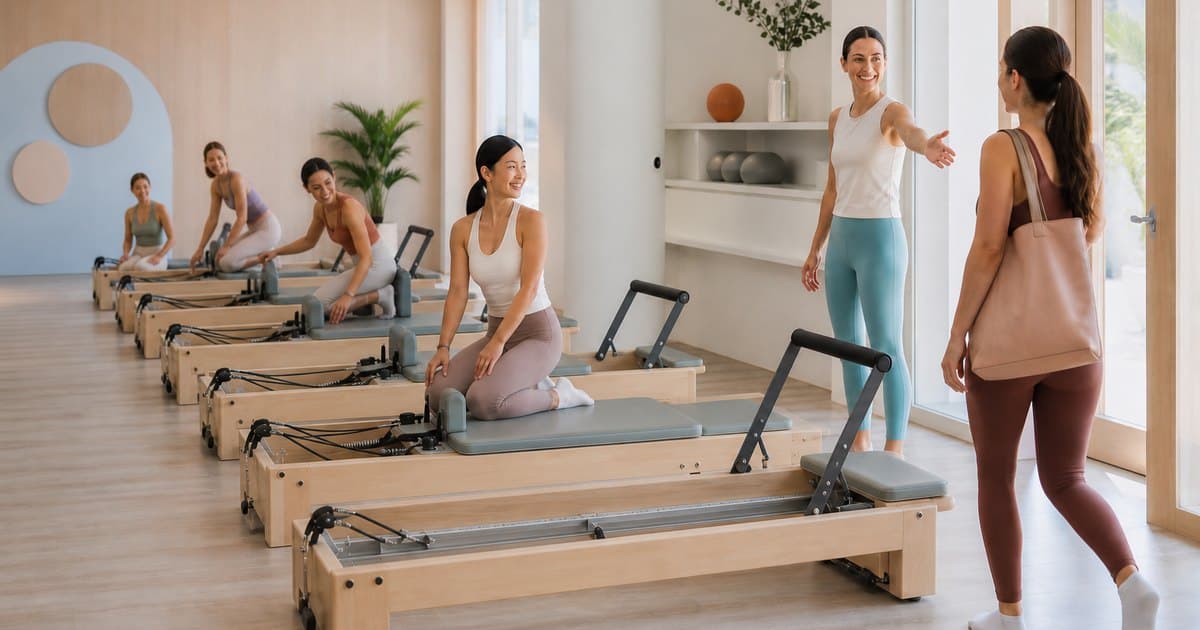
Demand for Pilates may cluster around certain times while other classes remain partly available. Even a busy studio can therefore have open places because of cancellations or lower-demand time slots.
In a Reformer studio, capacity is limited by the number of machines, so each open place represents part of the hourly capacity.
In this article, we will look at the math behind an unused Reformer and how to use the "drop-in" strategy to fill classes, turning schedule gaps into additional revenue and new customers.
Reformer class capacity
A Pilates Reformer class has an immediate physical constraint: the number of usable machines, alongside limits set for space, safety, and supervision.
With 6 Reformers, you can serve at most 6 participants per session. If two places remain unsold, 33% of capacity is available: that equals 33% of potential gross revenue only if every place has the same price and would normally sell. The actual economic effect also depends on credits, cancellation policy, and variable costs.
Higher occupancy can increase gross revenue, but break-even and profitability do not necessarily require 100%: they depend on average price, costs, the mix of memberships and one-off entries, and the number of classes.
Why waiting lists are not enough
A waiting list remains the first tool for reallocating a place to members. In some situations, however, it may not fill the class:
- Timing: a late cancellation gives people on the list less time to confirm and reach the studio.
- Commercial model: a place covered by a membership, credit, or single payment affects revenue, credit usage, and customer satisfaction differently. Analyse it in the context of your pricing model.
The solution: strategic drop-ins
One possible addition is to allocate a controlled share of places that remain available after the studio's defined member priorities to external customers.
Here is how to apply this strategy to Pilates:
1. Monetize off-peak hours
Use your studio data to identify lower-occupancy periods. Publishing some drop-in places may reach people with flexible schedules, but local demand and willingness to pay should be tested.
2. Manage cancellation windows (yield management)
Test a window that reflects members' booking habits, for example by publishing only a share of remaining places. Pricing also needs testing: a premium is not always sustainable, while a discount may affect member perceptions.
3. Use drop-in as lead generation
A single entry lets someone try the studio, instructor, and format before buying a package. Some guests may return, but conversion is not automatic: measure repeat purchases and which time slots create value.
Publish available places with FlexDropin
Alongside the commercial decision, you need an operational process: decide which places to allocate to drop-ins and publish current availability without creating conflicts with the main booking system.
This is where FlexDropin comes in. The application acts as a marketplace that connects your availability with those looking for single classes in your city.
- You publish your courses on the app, setting how many spots you want to allocate for drop-ins.
- You manually update published capacity when availability changes; automatic synchronisation with other management systems is not currently provided.
- Booking and payment happen instantly online.
- You receive the client and the revenue, without exchanging messages or handling cash at the front desk.
Drop-ins are a channel to measure: compare net revenue, operating costs, occupancy, member complaints, and repeat purchases before expanding it.