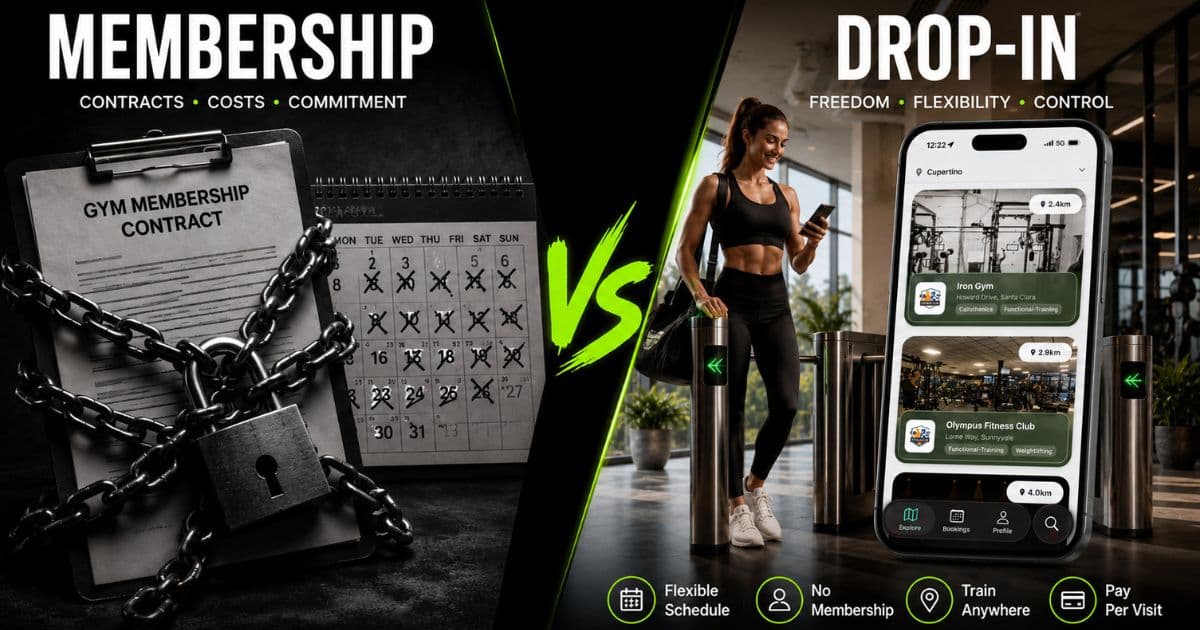
Paying only for the workouts you actually do is the great advantage of flexible fitness. However, when looking for a gym without a membership, you might notice that the cost of a single entry or drop-in class is proportionally higher than the per-visit cost of a yearly membership.
Is the difference justified? It depends on the city, activity, capacity, coaching, equipment, and included services: an average without a location, date, and sample can be misleading.
In this article, we will explore the real costs of pay-as-you-go fitness, explaining why prices vary and offering you a checklist to evaluate whether the fee requested by a studio aligns with the value offered.
Three types of offer to compare
To compare like with like, separate independent access, group classes, and limited-capacity classes. These categories describe the service, not universal price bands.
1. Open gym and day passes
A weight-room day pass generally provides independent access to space and equipment during stated hours. Check whether supervision, changing rooms, lockers, or time limits are included.
- Ideal for: Those who already know how to work out independently.
2. Group classes
This category includes coached classes such as functional training, yoga, HIIT circuits, or spinning. Duration, capacity, and coaching level may vary even between classes in the same activity.
- Ideal for: Those seeking group motivation and the guidance of an instructor.
3. Limited-capacity or equipment-specific classes
Pilates Reformer is one example: the number of machines limits participants and the setup affects costs. Small-group and equipment-specific sessions may also have different prices, but an affiliation or activity name alone does not determine value.
- Check: Maximum participants, instructor qualifications, and the level of individual adaptation actually provided.
Why does a drop-in cost more than a membership?
A fair comparison does not simply divide membership cost by the days in a month: actual attendance, included services, and commitment length matter. The single-entry price covers an occasional sale without guaranteed recurring revenue.
Membership gives the operator more predictability, while a drop-in gives the user more flexibility. This may lead to different unit prices, but it does not mean a drop-in has no rules: cancellation, refund, and entry requirements still apply.
4 criteria to evaluate the price of a class
Before booking, use this checklist to understand what you are comparing:
- Instructor-to-student ratio: a small group may allow more observation, but ask what assistance and adaptations are actually provided; group size alone does not guarantee them.
- Equipment: even a park class has staff, organization, permit, or insurance costs. Reformers, rowers, SkiErgs, and other equipment add purchase, space, and maintenance costs, but the amount varies by venue.
- Extra amenities: for example, if an entry costs €20, check whether it covers only the workout or also a towel, shower products, a locker, or sauna access.
- Cancellation rules: read the terms, deadlines, and any costs before paying. FlexDropin applies the platform policy rather than a different policy for each venue.
Compare prices published on FlexDropin
Evaluating prices can be difficult when drop-in costs and terms are not published clearly and you need to contact the front desk.
When partner venues publish their sessions, FlexDropin lets you review key details before booking. In the app, you can:
- Search partner venues by location and category and view the price of published sessions.
- Review published photos and descriptions; if an amenity or item is not listed, ask the venue to confirm it.
- Review the FlexDropin cancellation terms that apply to the booking before payment.
This lets you review the published price and available terms before choosing, booking, and training.