The right fitness class is not automatically the hardest, the most popular or the one that promises the fastest transformation. It is a class that supports your goal, meets you at your current level and fits your life well enough for you to attend consistently.
A useful choice comes down to five questions: what do you want to improve, where are you starting from, how do you like to train, how well is the class taught, and can you realistically keep attending? Shortlist two or three options, try them, and compare them using the same criteria. One class cannot predict every long-term result, but it can reveal a great deal about the instructor, environment, intensity and practical fit.
Why there is no single best fitness class
“What is the best fitness class?” is really several questions:
- best for which goal;
- suitable for which experience level;
- practical within which schedule, location and budget;
- enjoyable for which personality and training style.
A HIIT session, a Pilates class and a strength class are not simply three versions of the same workout. They may overlap, but they distribute aerobic work, resistance, technique, impact, coordination and recovery differently. The same label can also mean different things at different gyms. Functional training might be a carefully scaled circuit or a demanding conditioning session. Yoga can be slow and restorative or fast and dynamic. Pilates can use a mat, small equipment or specialised machines.
Treat the class description as a starting hypothesis and a trial session as the reality check. The name alone is rarely enough.
Filter one: what is your main goal?
You do not have to choose one goal forever. You do need a clear priority for the next couple of months, otherwise almost every class will appear both relevant and irrelevant.
Building strength and handling resistance
Look for sessions with a clear form of resistance and a way to progress over time: strength classes, well-structured functional training, calisthenics or classes using weights and resistance. Ask how movements and loads are adapted for new participants.
“Toning” is not a precise training method. If you mean becoming stronger and building or maintaining muscle, check that the class includes meaningful resistance rather than relying exclusively on fast movement with unchanged loads.
Improving aerobic fitness and endurance
Indoor cycling, dance fitness, cardio circuits and some functional classes can devote a substantial part of the session to aerobic work. The best match also depends on the experience you prefer: controlling resistance on a bike feels different from following choreography or moving between stations.
Intensity is not contained in the class name. The CDC notes that the same activity may feel moderate to one person and vigorous to another. The talk test is a simple reference: during moderate-intensity activity, you can generally talk but not sing.
Developing mobility, control and movement awareness
Pilates, yoga, mobility and some posture-focused classes may place more emphasis on control, breathing, balance, range of motion and movement quality. They are not interchangeable, and they are not automatically easy. Check the style, level, pace and equipment before booking.
Reducing stress and rebuilding consistency
If your biggest challenge is restarting and staying active, enjoyment may be a deciding factor. Music, community, a calm atmosphere, visible skill progress or technical focus can all make an activity more meaningful. A systematic review of self-determination research found consistent support for a positive relationship between more autonomous motivation and exercise. Intrinsic motivation — finding value or enjoyment in the activity itself — appeared particularly relevant to longer-term adherence.
That does not mean every minute needs to feel effortless or entertaining. It does mean that a class experienced only as punishment starts at a practical disadvantage.
Preparing for a sport or event
If you are training for a race, a demanding hike, a hybrid event or another sport, ask which abilities the class actually develops and how closely they transfer to your goal. A general class can be a useful complement, but it may not replace sport-specific work.
Filter two: what is your current starting point?
The right class should challenge you without requiring you to imitate someone with years of experience. Before booking, consider:
- what you have done in the past few months, not at your lifetime peak;
- familiarity with the movements and equipment;
- current tolerance for jumping, running, rapid direction changes or loading;
- any guidance you have received from a doctor or physiotherapist;
- how well you recover between sessions;
- whether a fast or crowded group helps or overwhelms you.
If you are returning after a long break, labels such as “intro”, “foundations”, “beginner” or “all levels with modifications” are more useful than a vague claim that everyone can join. Ask exactly how the class is scaled. A genuinely inclusive session offers easier and harder options without shaming anyone for using them.
If you have a health condition, a recent injury or concerns about vigorous activity, speak to the healthcare professional who knows your circumstances before choosing. During exercise, intense chest pain or pressure, severe or unexplained shortness of breath, unexplained dizziness or faintness are reasons to stop and seek medical advice before resuming, not milestones to push through.
Comparison table: which classes should you consider?
This table is a starting point, not a ranking. Commercial names do not guarantee content, intensity or quality, so always check the actual class description.
| Format | Usual focus | Typical experience | Ask before booking | It may suit you if… |
|---|---|---|---|---|
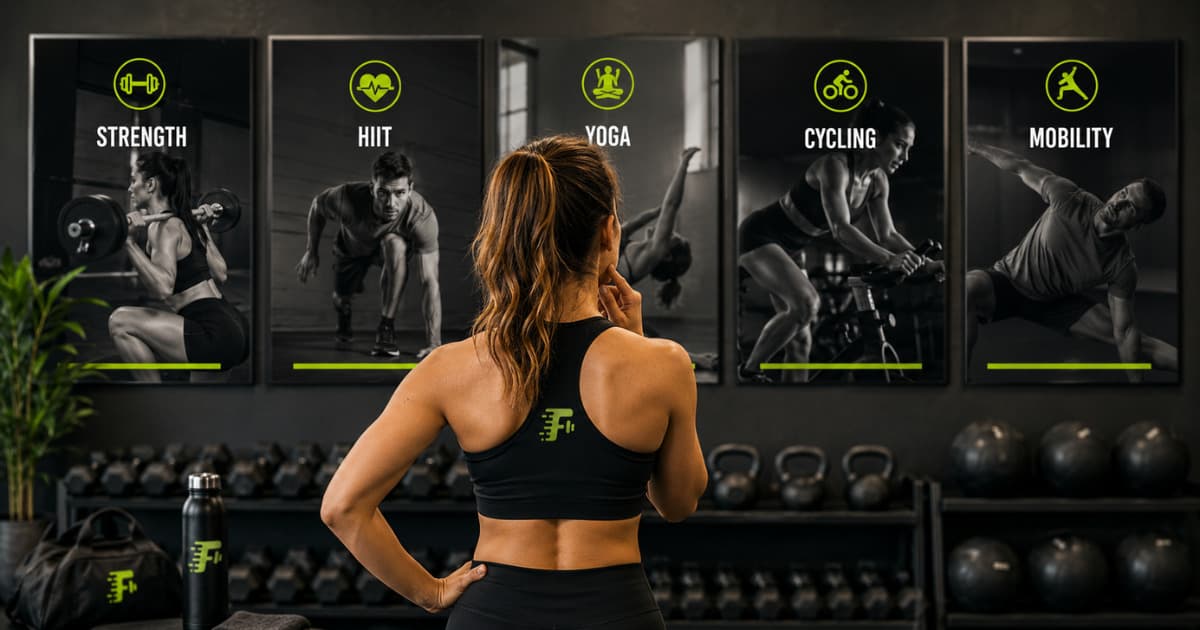
| Strength / resistance class | Resistance, technique and progression | Controlled pace with sets and rest | How are loads selected and progressed? | you want to build strength and learn resistance movements |
| Functional training | Multi-joint movement, general strength and conditioning | Circuits or blocks; intensity varies widely | Is every movement scalable for beginners? | you enjoy variety and mixed physical demands |
| HIIT / circuit training | Work-and-recovery intervals | Fast-paced and time-efficient | How can impact and intensity be reduced? | you have a base level and enjoy structured intervals |
| Indoor cycling / cardio | Aerobic fitness and pacing | Continuous work or music-led intervals | Can I control resistance throughout? | you want cardio with guided movement |
| Pilates | Control, stability, breathing and precision | Deliberate movement; mat or equipment | Which method, level and equipment are used? | you value technique, control and gradual progression |
| Yoga | Mobility, balance, breathing and mind-body practice | Ranges from slow to highly dynamic | Which style and level is being taught? | you want movement combined with focused attention |
| Calisthenics | Bodyweight strength and skill | Technical progressions for pushing, pulling and holds | What prerequisites are expected and how are drills scaled? | measurable skills and bodyweight training motivate you |
| Dance fitness | Coordination and aerobic work through music | Continuous, social and choreography-led | How complex is the choreography for a first-timer? | music and group energy help you stay consistent |
You do not need a single class that does everything. Over time, combining complementary activities is often more realistic than expecting one hour to cover strength, aerobic fitness, mobility, technique and recovery equally.
Filter three: what experience makes you want to return?
Exercise selection is not only about the exercise list. Two classes with the same programme can feel completely different because of the instructor, music, group size and atmosphere.
Ask yourself:
- do I prefer detailed technical instruction or a more continuous flow;
- does music motivate me or distract me;
- do I want a social group or minimal interaction;
- does competition energise me or create unhelpful pressure;
- do I prefer a repeatable structure with measurable progress or frequent variety;
- do I feel safer in a small class or more energised in a large room.
A qualitative synthesis of 68 studies about how adults maintain physical activity identified several interacting themes: enjoyment, habits, social support and accountability, access, cost, flexibility and the ability to make activity work within everyday life. The practical conclusion is not that one motivational formula works for everyone. It is that the environment matters alongside the workout itself.
Filter four: how to recognise a well-run class
A hard class can be taught responsibly, while an easy-looking class can be poorly organised. Judge how the session is delivered, not just how much you sweat.
Positive signs
- the instructor explains the session's purpose and structure;
- first-time participants are acknowledged and shown available modifications;
- movements are demonstrated or explained clearly;
- easier and harder variations are offered without judgement;
- the instructor watches the room instead of doing their own workout;
- feedback is respectful and technique is prioritised when needed;
- class size, spacing and equipment support safe participation;
- the atmosphere encourages effort without glorifying pain or exhaustion.
Red flags
- participants are encouraged to ignore acute pain, dizziness or significant symptoms;
- inaccessible exercises are given with no alternatives;
- beginners are pressured to use loads or speeds they cannot control;
- overcrowding prevents adequate spacing or supervision;
- humiliation, body comparison or punishment is used as motivation;
- pricing, renewal and cancellation rules appear only after the trial;
- aggressive sales pressure replaces the opportunity to ask questions.
An occasional organisational mistake can happen. A genuine safety concern or an environment that repeatedly makes you uncomfortable should not be cancelled out by good music, popularity or a calorie number on a screen.
Filter five: does the class fit your real week?
The theoretically perfect class loses value if the journey is unrealistic, the timetable clashes with work or every unexpected change becomes expensive. Before deciding, check:
- total time, including travel, required early arrival and changing;
- times you can maintain during ordinary weeks;
- how often the class runs;
- single-session price, packages and extra costs;
- cancellation and wait-list policies;
- required equipment, clothing or documentation;
- how easy it is to book;
- your realistic attendance probability, not your ideal-week prediction.
The U.S. government's Move Your Way activity planner begins with activities, days and available minutes. The principle is useful anywhere: a fitness class does not exist in isolation. It needs to fit alongside other activity and the rest of your life.
The three-trial method
It is difficult to compare different classes from memory. Try up to three promising options and, immediately afterwards, score five factors from 1 to 5.
| Criterion | 1 point | 3 points | 5 points |
|---|---|---|---|
| Match with your goal | the connection is unclear | it partly supports my goal | the focus is relevant and clearly explained |
| Enjoyment and engagement | I cannot wait to leave | the experience is neutral | I genuinely want to return |
| Instructor clarity | instructions are missing or confusing | explanations are adequate | instructions, feedback and options are clear |
| Physical sustainability | I cannot control the work | challenging but adjustable | stimulating and appropriate for my level |
| Practical sustainability | time, location or price is unrealistic | it requires some compromises | it fits my routine well |
The total ranges from 5 to 25. It makes comparison more transparent, but it is not a safety certificate. A serious red flag cannot be offset by high scores for music and convenience.
Write down three short answers too:
- what did I genuinely like;
- what was difficult, and could it be modified;
- what do I need to ask before attending again.
If the format appeals to you but the first experience was unclear, consider a different instructor or an introductory class before rejecting the entire discipline. If you simply dislike the activity, moving on is useful information, not failure.
Questions to ask before a trial class
A short message can prevent a poor booking. Ask:
- is the session suitable for someone starting from zero;
- which movements and equipment are used;
- are there alternatives to jumping, running or advanced exercises;
- how early should I arrive;
- what do I need to bring;
- how many people usually attend;
- is this a one-off purchase or does it activate a renewal;
- what is the cancellation policy.
If you have a specific limitation, do not ask the instructor to diagnose it. Share the relevant guidance from your healthcare professional and ask whether the class can accommodate it.
How to evaluate the class after a few weeks
Do not judge a class only by how tired you felt on day one. After three or four visits, look for a pattern:
- the structure and movements are becoming clearer;
- you can choose suitable modifications;
- recovery remains compatible with the rest of your week;
- you notice small, goal-relevant improvements;
- the instructor remains attentive after the trial period;
- booking and attending are becoming a manageable habit;
- you want to return often enough to build consistency.
A lack of immediate results does not automatically mean the class is ineffective. Strength, skill, endurance and mobility take time. Early on, the strongest signal is that the process feels appropriate, understandable and repeatable.
One class or complementary activities?
As general public-health guidance, the World Health Organization recommends that adults complete 150 to 300 minutes of moderate-intensity aerobic activity per week, or 75 to 150 minutes of vigorous activity, or an equivalent combination. It also recommends muscle-strengthening activity involving major muscle groups on at least two days per week. Older adults and people with specific conditions may need additional or adapted guidance.
These numbers are not a personal programme and do not measure the quality of a single session. They do show why one class may support one area without covering everything. For example:
- a strength class can sit alongside walking, cycling or an aerobic class;
- a cardio class can be combined with strength work;
- yoga or Pilates can complement aerobic and strengthening activity, depending on their content and your goals;
- a demanding week may call for recovery, not another high-intensity class.
The goal is not to fill every day. It is to create a combination you can maintain and adjust as your goals and availability change.
The best choice starts with an informed trial
Choosing a fitness class does not require predicting the future or signing a long commitment immediately. It requires narrowing the field, observing carefully and comparing real experiences.
Use this order:
- define one primary goal;
- shortlist two or three plausible formats;
- check the level, instructor and practical details;
- try each option using the same criteria;
- choose the one that combines fit with repeatability;
- review your choice after a few weeks.
Single classes are especially useful during this stage. They let you test a discipline, gym and instructor without turning an initial experiment into a long-term obligation. FlexDropin helps you discover available sessions and book only the classes you want to evaluate. The purpose is not to switch randomly every week, but to compare a few options before choosing one worth returning to.
Sources and further reading
The sources support the general information provided in the article. They do not constitute an individual assessment and do not imply an affiliation with FlexDropin.
- World Health Organization — Guidelines on physical activity and sedentary behaviour
- CDC — What Counts as Physical Activity for Adults
- U.S. Department of Health and Human Services — Move Your Way activity planner
- Teixeira et al. — Exercise, physical activity, and self-determination theory: a systematic review
- Madigan et al. — Understanding adults' experiences and perceptions of how to maintain physical activity: systematic review and qualitative synthesis
- Newcastle Hospitals NHS Foundation Trust — Exercise and your health: a guide to getting started
- NHS Better Health — How to be more active